In the rapidly evolving landscape of artificial intelligence, two major players stand out: Google’s Gemini and OpenAI’s ChatGPT. As we move deeper into 2025, many users and businesses are asking: which one is truly ahead? Let’s compare their strengths, weaknesses, use-cases, pricing, and integrations to help you decide which might be the better fit for your needs.
1. What Are Gemini & ChatGPT?
- ChatGPT from OpenAI started as a groundbreaking conversational model that made AI accessible to millions. It continues to evolve, offering new features, plugins, and integrations.
- Google Gemini (formerly Bard) is Google’s answer to generative AI. Built to leverage Google’s vast data ecosystem, it emphasizes multimodal inputs (text, images, audio), deep reasoning, and seamless integration across Google services. Wikipedia+1
2. Strengths & Highlights
Gemini’s key strengths:
- Strong ecosystem integration with Google Search, Docs, Gmail, Maps. G2 Learning Hub+1
- Multimodal input capabilities (text + image + audio + video) built into the model. G2 Learning Hub+1
- High context window in newer versions (e.g., 1 million tokens for deep tasks) for handling large documents or multi-step reasoning. G2 Learning Hub
ChatGPT’s key strengths:
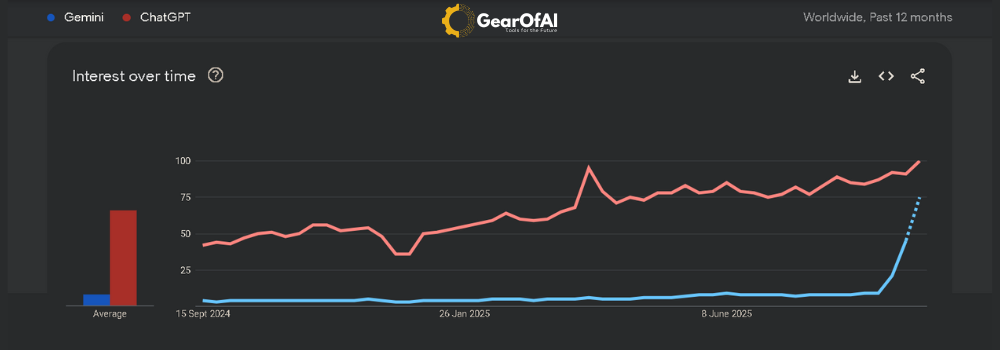
- A large and loyal user base, extensive plugin ecosystem, and strong creative writing and conversational abilities. Data Studios ‧Exafin+1
- Proven performance on long-form text generation, storytelling, and flexible custom GPTs. Tom’s Guide
3. Use-Cases: Which One Fits Best?
| Use-Case | ChatGPT Advantage | Gemini Advantage |
|---|---|---|
| Creative writing / storytelling | More natural tone, diverse prompts Tom’s Guide | Slightly more formal, accuracy-focused |
| Research & factual queries | Excellent, but knowledge cutoff somewhat older G2 Learning Hub | More recent training data, tight accuracy Label Your Data |
| Multimodal content (images/video) | Strong via DALL-E, GPT image features | Built-in multimodal, strong image/audio/video support Fluent Support |
| Ecosystem / integrations | Wide third-party ecosystem | Deep Google service integration (Docs, Gmail, Maps) Tom’s Guide |
| Context-heavy workflows | Good up to a point | Very high token limit in Gemini, better for long docs G2 Learning Hub |
4. Pricing & Accessibility
Both tools offer free tiers and premium versions. For example:
- Gemini’s advanced model (Gemini 2.5 Pro) is discussed as offering large context windows, multimodal support, and deep reasoning capabilities. G2 Learning Hub+1
- ChatGPT continues with the familiar “Plus” tier and extended features via custom GPTs, plugins, and advanced models. Data Studios ‧Exafin
For most users, the decision may come down to which ecosystem they already use (Google vs. OpenAI) and which features they prioritize.
5. What’s the Verdict?
There’s no clear “winner” in all scenarios — each tool excels in different areas.
- Choose ChatGPT if your focus is on creative writing, conversational nuance, or you already leverage the OpenAI ecosystem.
- Choose Google Gemini if you work heavily within Google’s suite, need high-context workflows, or plan to use multimodal inputs (images, audio, video) frequently.
In short: it depends on your use-case.
6. Final Thoughts
The AI race in 2025 isn’t just about raw model power — it’s about how the tools integrate into your workflow, how natural the experience feels, how recent the data is, and how well the system handles your specific tasks. Both ChatGPT and Gemini continue to improve rapidly, so staying tuned for updates is key.